The Votes Are In!
2024 Readers' Choice is back, bigger and better than ever!

 View Winners →
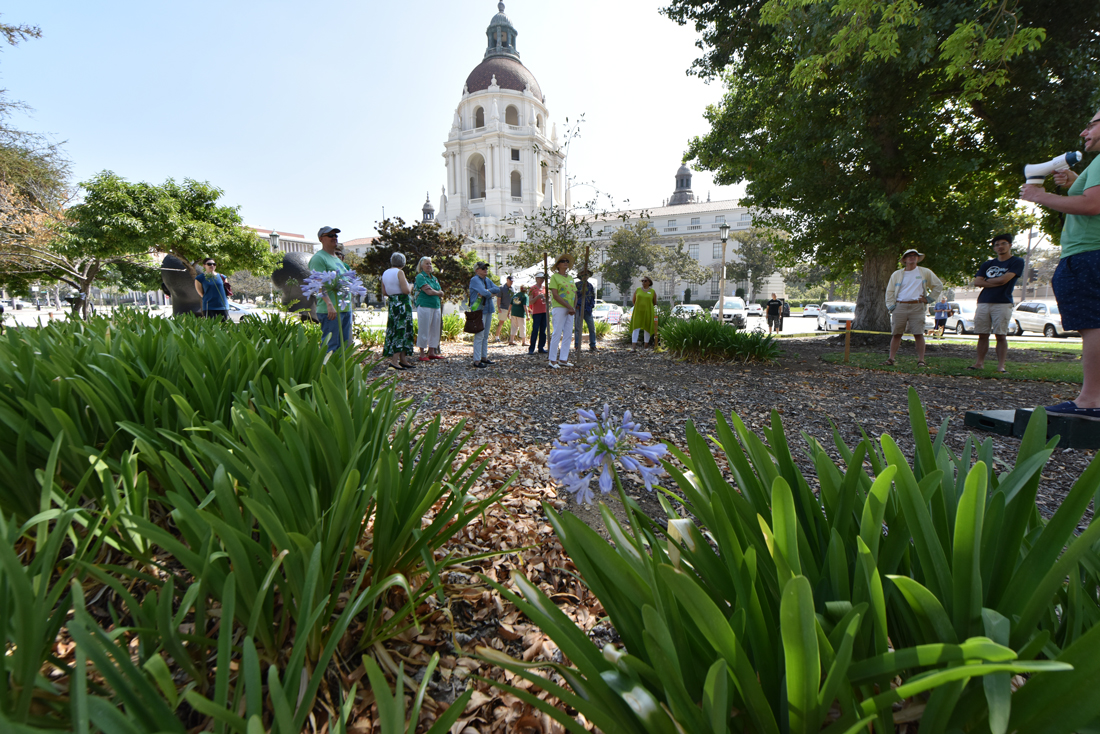
The hotel project would demolish and remove almost all of the 1923 voter-approved parkland across from City Hall. -Photo by Terry Miller
The Pasadena Civic Center Coalition (Pasadena CCC) filed a court challenge to the City of Pasadena’s approval to build a six-story, 185-room hotel located on city-owned land directly across from the Pasadena City Hall and within the Pasadena Civic Center National Register Historic District (PCCNRD).
Build in 1927, the Pasadena City Hall is a City of Pasadena Historic Monument, a California Historic Landmark, and the most significant contributing building of the PCCNRD. The Pasadena Civic Center is nationally recognized as one of the best examples of Beaux-Arts design inspired by the City Beautiful movement of the early 1900s.
Pasadena CCC is an organization of citizens representing historic preservation, planning and real estate finance professionals who seek to preserve the historic features and garden-like setting of the Civic Center.
Pasadena CCC supports the rehabilitation of the Julia Morgan-designed YWCA building and believes this historic building can be rehabilitated without sacrificing the monumental setting of the City Hall and the integrity of the PCCNRD.
The hotel project would demolish and remove almost all of the 1923 voter-approved parkland across from City Hall, a critical element of the City Hall’s garden-like setting and a key feature of the Pasadena Civic Center district to make way for a six-story hotel room tower. Ann Scheid, noted architectural historian and Pasadena CCC member states, “Building on this open space blocks views of City Hall and of neighboring historic buildings as well as impacting two important civic memorials: the Robinson Memorial and Pasadena’s Sister City Trees.” Throughout the administrative process, Pasadena CCC and many local citizens urged the City and its developer to keep their promise to protect the YWCA building and restore it as part of a small boutique hotel. Yet in closed-door negotiations, the City instead gave in to short-term unsupported economic demands of the developer and agreed to give away public parkland and open space that frames the historic City Hall, to accommodate a massively over-scaled project.
The lawsuit alleges the City violated the California Environmental Quality Act (CEQA) by certifying an Environmental Impact Report (EIR) that fails to consider many of the project’s impacts, including those to cultural resources, loss of trees, and traffic impacts related to no on-site parking. In addition, the EIR does not address the project’s inconsistency with General Plan and Specific Plan policies regarding the protection of open space. The litigation also alleges violations of the State Surplus Land Act and the Pasadena Municipal Code’s requirements for disposal of surplus property because the project allows private for-profit use of land that is currently public open space.
“The City of Pasadena failed to adequately evaluate the impacts of the historic district as a whole; did not evaluate the impacts to immediately surrounding contributing buildings, including City Hall; and failed to address the cumulative environmental impacts over time to the historic Civic Center from loss of public open space” said Amy Minteer, a partner at Chatten-Brown & Carstens, the firm representing the preservation-focused group. “A revised environmental impact report is required to thoroughly analyze and mitigate those impacts before this project can move forward.”
Pasadena CCC member Jonathan Edewards said “the City started with a proposal to push the back end of this hotel into the face of City Hall, and preceded to ‘back into’ all the environmental findings required to justify the project. From the beginning, the City cut corners in a desperate attempt to obtain project approval through a rigged public process.”
Edewards continued, “We couldn’t just stand by and ignore the threat of irreversible damage to Pasadena’s Civic Center. In an unprecedented move in 1923, Pasadena citizens bought the land and financed our Civic Center buildings that created the heart of the City with the dome being one of the most recognizable city landmarks. As the July 1980 National Register nomination form states, the Civic Center has a park-like character: it was ‘planned around the citizen—truly a place for people, to walk, to picnic and sunbathe, and to sit with friends among the trees and enjoy the open vistas.’ This legal action is only part of our efforts to ensure a better Civic Center for all Pasadena citizens.”
We are able to provide high-quality political journalism to you for free thanks to our advertisers. So that you can continue to enjoy HEYSOCAL's in-depth reporting, we ask that you please turn off your ad blocker and come on in, free of charge.
Subscribe to our newsletter for this giveaway and many more. Also, stay in the loop for SoCal news and updates.
Your subscription has been confirmed. You've been added to our list and will hear from us soon.
Your request has been confirmed! We will get in touch with you shortly.